It's not easy to imagine a more
simple circuit design than the lay out from the AVUS. Two five Mile
long straights connected with loops on both sides. But the AVUS is not
an ordinary race track. In fact is was the Worlds first motorway!
During the week it was used as toll way for the traffic from Berlin
to Wannsee and Potsdam. And during the weekend there could be
organized race events. For racing and testing there where two loops
constructed, the "Nordkurve" (North Curve) and the "Südkurve" (South
Curve), both about 5º banked.
Just like the traffic
in Germany, the racing cars also drove right at the Motorway part of
the AVUS. Which made that the circuit was driven anticlockwise. The
length of the circuit was 19,573 km (12.160 Miles). There was also a
shorter version for motorcycle races from 8,3 km (5.157 Miles) which
did not use the Southern loop.

A
reconstruction came in 1936 when a new road was planned to the
exposition site next to the AVUS. The Nordkurve should make place
for this new road, but to compensate the AVUS a new Nordkurve was
constructed. This new corner was paved with bricks and had a banking
of 43,6º! This
made the AVUS the fastest circuit in
the World. Also a new office building (Now the AVUS motel) and an
new main grandstand where built. In the spring of 1937 the renewed
AVUS was ready and the first race was held in may. That race was won
by Hermann Lang in his Mercedes with an average speed about 260 km/h
(160 Mph) with top speeds about 380 km/h (225 Mph). These records
would stand for more than three decades!
-duitsland.jpg)
In 1938 the AVUS was connected with
the expanding web of German Motorways. For this the Südkurve was
demolished. There where plans to build a high banked Südkurve, but
the out broke of the Second World War in September 1939 stopped
these plans. After the war first races at the AVUS where held in
1951 at the shorter version from 8,3 km
(5.157 Miles), which was used
before the war for motorcycle races. In state of a long loop, the
Southern turning point was now a flat corner which looked like a bus
stop.

For political reasons the 1959 German
Grand Prix was held at the AVUS to give the people in the Russian
occupation zone the change to visit the race (NB: The Berlin wall
was built in 1961). As a gesture to the East German fans they could
pay their ticket in East Marks. This should be the only official
Formula 1 Grand Prix at the AVUS (In 1954 there was also a Formula 1
race at the AVUS which was not counting for the championship). The
Saturday before the Grand Prix Frenchman Jean Behra was killed
during a supporting sports car race. He slid on the banked
Nordkurve, flew over the top and crashed into the remains of the
foundation of
an anti-aircraft gun from the Second World War. During the Grand
Prix on Sunday everything went well and both heats where won by
the British driver Tony Brooks in his Ferrari. It was the only
Formula 1 race ever which was driven in two heats.

Because the banked Nordkurve was
found to dangerous the corner was demolished and replaced by a flat
version in 1967. From 1975 on, the AVUS was just twice a year closed
for racing. The rest of the year it was the motorway who connected
West Berlin to West Germany. In 1989 the track was shortened to
4.879 km (3.032 Miles). The Southern corner was reduced to an
additional piece of asphalt at the turning point. From 1984 to 1995
a combined event from the German Touring car Championship (DTM) and
the German Formula 3 Championship was the annual highpoint at the
AVUS.

In 1992 new safety measurements where
applied. To reduce speeds the straights where shortened again and
the South corner was just a gap in the guardrail to turn. There was
also a
chicane created in front of the North loop. Unless the new
safety measurements a lot of crashed happened during the touring car
events (most of them caused by rude driving) who are feeding the
discussions about the safety of the street course. In September 1995
the British driver Keith O'dor spun at the entrance of the Nordkurve
during a Super Touring car Cup (STW) race. Frank Biela hits him in
the door on the drivers side. He was passed away the next morning in
the hospital. From that moment the track was criticised more and
more. New safety measurements where required for the 1996 race. A
second chicane was added just before the Nordkurve and all bumps
where removed. But the end of the AVUS street circuit came closer
when a new permanent circuit was built not far from Berlin.

Close to Berlin a brand new modern
circuit complex, containing an oval, a road circuit and a test
track. This complex called the Lausitzring was opened in 2000 and
was a good alternative for the AVUS with his boring lay out and all
the safety problems. At the first of May 1999 the AVUS street
circuit was said goodbye with a great event. All historic cars who
ever drove at the historic circuit where taken from their museums
for a final meeting at the AVUS.

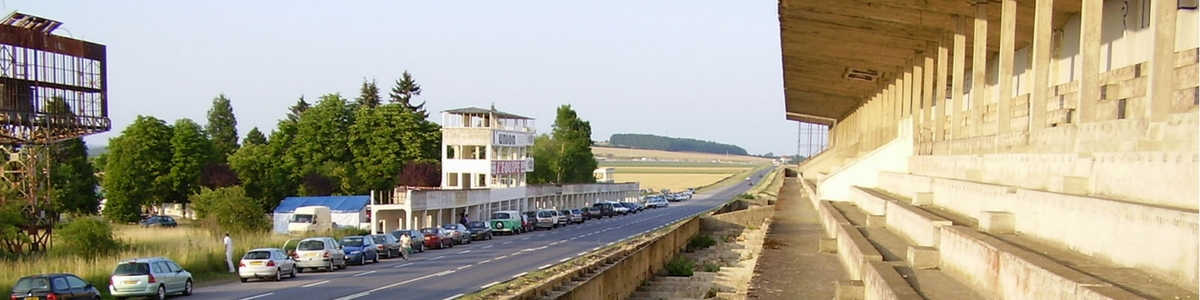
When you travel today to Berlin over
the A115 you still see the old grandstand and control tower with the
former office building next to the motorway. These buildings are now
National Monument. The tower and offices are now in use as a motel.
Because the grandstand cost the Government too much money they sold
it in 2006 to an investor who let build an Autosalon and a
restaurant inside.

Discuss
this circuit at the forum.
